

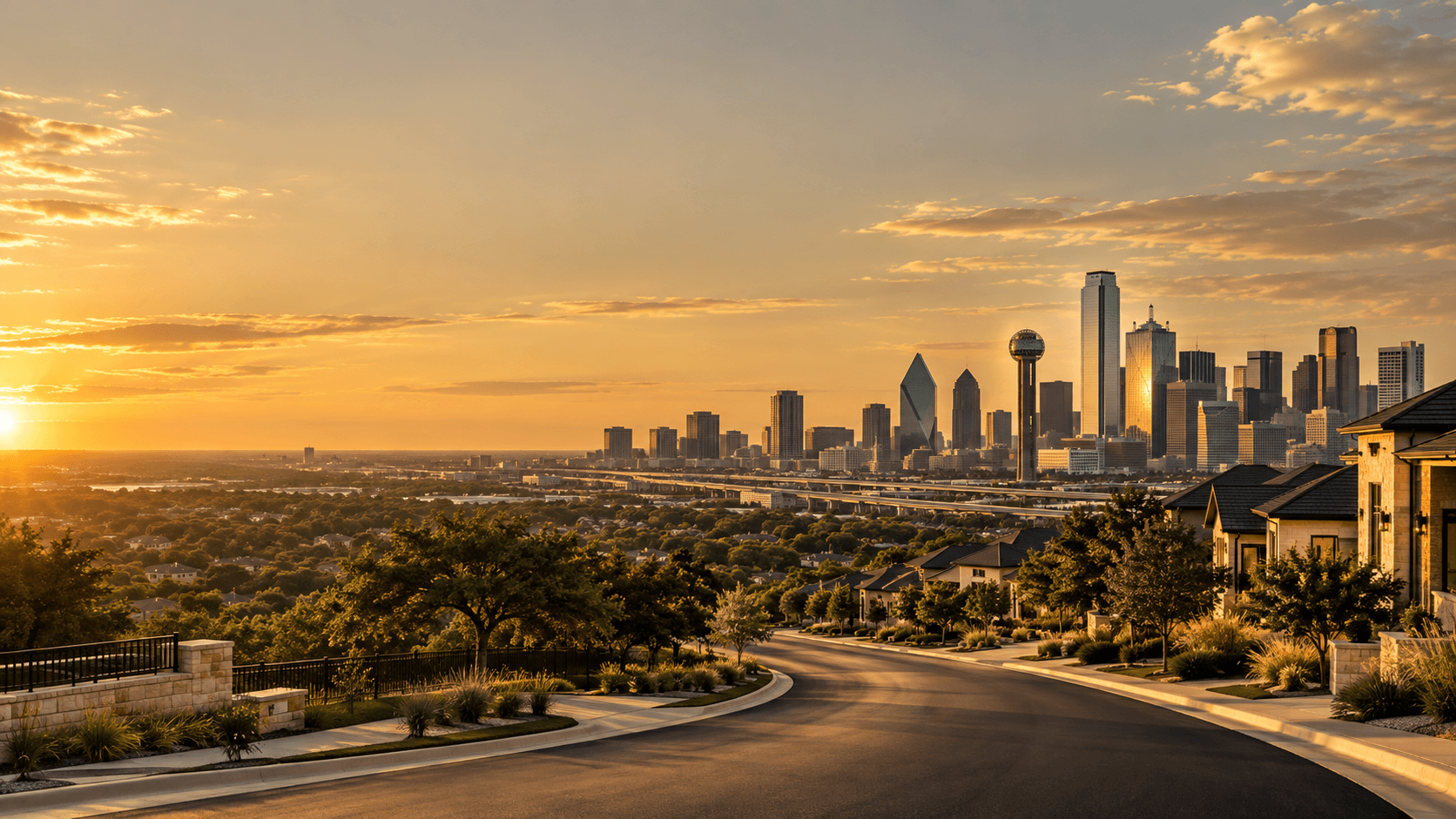
Moving to North Richland Hills, Texas?
Here's How to Buy New Construction the Right Way.
A practical guide for out-of-state buyers — communities, builders, build timelines, what things actually cost, and why having your own agent protects you from day one.
Neighborhoods, commute, climate, schools, and who loves it here.
New-construction communities in and around NRH.
A phased schedule from initial research through move-in day.
The builder's rep works for the builder. Here's what changes when you have your own.
What Living in North Richland Hills Is Actually Like
North Richland Hills is the largest of the Mid-Cities at about 70,000 people — and the one that kept building. Two TEXRail stations, the NRH2O family waterpark, and a pair of genuinely walkable new-home districts make NRH the exception to the built-out Mid-Cities rule, all while keeping the every-direction commute math that defines this part of the metro.
Location and Commute
NRH sits on Loop 820 with SH-26 and Davis Boulevard threading north — downtown Fort Worth in 15 to 20 minutes, DFW Airport in 20, the Alliance corridor 15 minutes north, and downtown Dallas about 35. Two TEXRail stations (Smithfield and Iron Horse) run commuter rail to downtown Fort Worth one direction and DFW Terminal B the other.
That rail access is rare currency in Tarrant County — and both of NRH's flagship new communities sit within minutes of a station.
Climate
Summers are hot — highs in the mid-90s to low-100s from June through September, with real humidity that Arizona and Nevada transplants notice immediately. The tradeoff is a long, pleasant fall, mild winters with daytime highs typically in the 50s and 60s, and an early spring. Occasional winter ice storms happen and the metro largely shuts down for a day or two when they do.
Spring storm season (roughly March through June) brings the weather North Texas is known for: dramatic thunderstorms, occasional hail, and a real if statistically small tornado risk. New construction here is built with this in mind — engineered roofing, impact-resistant shingle options, and storm-rated garage doors are common upgrades worth discussing. Hail is also the main driver of Texas homeowner's insurance premiums, which we cover in the cost-of-living section below.
Schools
NRH splits between two districts: most of the city feeds Birdville ISD — anchored by Richland and Birdville high schools with strong career-tech and fine arts programs — while the city's northern reaches feed Keller ISD. The boundary meaningfully affects value, and it runs through the middle of the new-construction map, so we verify the attendance zone for every lot.
Healthcare
Medical City North Hills is inside the city, with Texas Health Harris Methodist HEB minutes east and the full Fort Worth medical district — including Cook Children's — 20 minutes southwest. Texas Health Alliance serves the northern commute.
Shopping, Dining, and Recreation
North East Mall's retail ring is minutes away, NRH2O — the city-owned waterpark — anchors family summers, and the growing City Point district is adding restaurants and shops within walking distance of its new homes. Historic Grapevine and Southlake Town Square are each 15 minutes out.
The Cotton Belt Trail runs along the TEXRail corridor for cyclists and runners, linking NRH's parks to Grapevine and Colleyville.
Who Loves It Here
- Walkable-district buyers at City Point and Hometown — new urbanism at Mid-Cities prices.
- Rail commuters riding TEXRail to downtown Fort Worth or straight into the airport terminal.
- Every-direction households splitting careers between Dallas, Fort Worth, and the Alliance corridor.
- Value-focused families choosing between Birdville and Keller ISD zones without leaving the city.
New Home Communities In & Around North Richland Hills
NRH carries more true new construction than any Mid-Cities neighbor — one marquee urban village, one long-running new-urbanist community, and steady infill. Here's the landscape.
City Point
Urban VillageThe Mid-Cities' biggest new-home story: a 50-plus-acre redevelopment of the former North Hills Mall site into a walkable district of townhomes and single-family homes around shops, restaurants, parks, and a new city hall — minutes from TEXRail.
Phases continue delivering; product and pricing vary by builder and block, and the best positions move on release. We track every phase opening.
Hometown
New-Urbanist CommunityNRH's long-running new-urbanist community around The Lakes and NRH2O — front porches, alley-loaded garages, walkable streets, and its own town-center feel, with final phases and occasional new releases continuing.
A settled alternative to City Point's newer energy: finished streetscapes, established lakes and trails, and a proven resale record.
Birdville & Keller ISD Infill
InfillScattered lots, small enclaves, and teardown-rebuilds across the city's established neighborhoods — including the Keller ISD-zoned north side, where infill new builds carry a district premium.
We source lots, verify the district line precisely, and match buyers with the builders working each pocket.
Quick Move-Ins Across NE Tarrant
Move-In ReadyFor relocation timelines, completed specs across the NRH orbit — Watauga, Haltom City's newer sections, and Keller ISD-zoned north Fort Worth — close in 30 to 45 days.
Quarter-end brings the deepest discounts on standing inventory; we track which specs carry the strongest incentives.
The Relocation Timeline: From First Search to Move-In
New construction in DFW typically takes 6 to 9 months from contract signing to closing, with quick move-in inventory homes closing in as little as 30 to 60 days. That build window is actually an advantage for out-of-state buyers — it gives you a defined runway to prepare everything on your end. The key is understanding how your pre-move tasks sequence against the builder's construction schedule.
Initial Research and Community Selection
This is the phase most buyers start from their couch — and the most important one to do thoroughly before flying out. Research the communities that match your priorities (school district, commute, price range, lifestyle). Use Google Street View, community websites, and builder websites to narrow down. Read HOA documents and confirm whether a community sits in a MUD or PID district for any community you're seriously considering.
- Identify 2 to 4 communities that match your criteria
- Verify school district attendance zones for each — Texas boundaries don't follow city limits
- Understand which builders are active in each community
- Connect with a buyer's agent before visiting — the on-site rep works for the builder
Financing Pre-Approval
Get pre-approved before you tour a single model home. Builders will take you more seriously, and you'll have leverage in negotiations. Compare your own lender against the builder's preferred lender — DFW builder lenders are currently offering some of the most aggressive incentives in the country (rate buydowns, closing cost credits) but are not always the most competitive on the underlying rate. Understand how extended rate-lock programs work for new construction, since you won't be closing for 6 to 9 months.
- Obtain pre-approval from at least one outside lender
- Ask each builder about their preferred lender incentives
- Understand extended rate-lock and float-down options
- Get clear on your construction deposit requirements (typically 1–10% earnest money plus design center deposits)
Site Visit, Lot Selection, and Contract
If possible, visit DFW in person before signing. Tour 2 to 3 communities, walk available lots, and compare model homes. Your agents should accompany you or, if you can't fly out, help you evaluate lots and floor plans remotely using satellite imagery, community phase maps, and their on-the-ground knowledge. Once you've selected your community, floor plan, and lot, contract signing begins the official build clock.
- Walk all available lots in your target community before selecting
- Review the purchase contract thoroughly with your agent before signing — pay attention to delay clauses, earnest money terms, and upgrade addenda
- Make design center selections (structural options, flooring, counters, cabinetry) typically within 30 days of signing
- Make your earnest money deposit per contract terms
Foundation, Slab, and Framing
The builder breaks ground, pours the slab, and begins framing. North Texas soils are expansive clay, so foundation engineering matters here — post-tension slabs are standard and a pre-pour inspection is worth discussing. This is often the most visually exciting phase — your lot goes from dirt to a recognizable structure quickly. Larry and Laura visit the site during framing and send photos and video so you can see the progress from wherever you are.
- Begin researching schools and enrollment requirements for your district
- Start decluttering and preparing your current home for sale if you own
- If renting currently, give your landlord proper notice per your lease
Rough Mechanicals and Pre-Drywall
Plumbing, electrical, HVAC, and framing inspections happen before walls are closed. This is the single most important phase to have an independent inspector involved. A pre-drywall inspection can identify framing errors, plumbing rough-in issues, or missing insulation that would be expensive and disruptive to correct after drywall goes up. We coordinate this inspection and walk the site with your inspector if you can't be there in person — and we provide every client a free pre-drywall inspection checklist.
- Schedule your independent pre-drywall inspection — do not skip this
- List your current home with a local agent if you are selling
- Continue rate monitoring; consider locking if your lender advises it
Drywall, Interior Finishes, and Systems
Drywall goes up, paint is applied, flooring is installed, cabinets and counters go in. The home starts to look finished well before it is. Your selections from the design center come to life during this phase. We photograph progress at key milestones — especially once your flooring and cabinetry are in — so you can verify your selections are correct before closing.
- Confirm your current home sale is on track or arrange bridge financing if needed
- Research moving companies and get at least 3 quotes — good long-distance movers book out weeks in advance
- Research Texas homeowner's insurance early — hail history makes DFW premiums and roof coverage terms very different from other states
- Contact your children's new school about enrollment requirements
- Compare retail electricity providers — most of DFW is deregulated, so you choose your own electric plan
Final Inspection, Walkthrough, and Closing
The builder requests a Certificate of Occupancy once construction is complete and all city inspections pass. You'll have a final walkthrough (orientation) with the builder, followed by closing. Schedule your own independent inspector for a final inspection before closing — even brand-new homes have issues that are far easier to address as a warranty item before you take title than after. We accompany you through the walkthrough and help document every item on your punch list.
- Schedule an independent final inspection before your builder walkthrough
- Review all closing documents carefully — confirm your loan terms match what was quoted
- Confirm your homeowner's insurance is bound and effective at closing
- Finalize mover booking and confirm your move-in date
Move-In, Texas Registration, and Warranty Period
Once you have keys, the builder's warranty period begins. Most Texas builders offer a one-year workmanship warranty, a two-year systems warranty (mechanical, plumbing, electrical), and a ten-year structural warranty. Document any warranty items immediately — photograph issues and submit them in writing per the builder's warranty process. Your agent can advise on what qualifies and how to escalate if the builder is unresponsive.
- Submit warranty items in writing within the first 30 days
- File your Texas homestead exemption with the county appraisal district — it reduces your taxable value and caps annual assessment increases on your primary residence
- Register your vehicles in Texas (within 30 days of establishing residency) and obtain a Texas driver's license (within 90 days)
- Update voter registration, banking addresses, and professional licenses as required
- Set up utilities — choose your retail electricity provider (Oncor delivers in most of DFW), Atmos Energy for gas, and city water/sewer/trash for your address
- Set up your HOA account and review CC&R rules for your community
Why You Need Your Own REALTOR® When Buying New Construction
The single most common mistake out-of-state new-build buyers make: walking into a model home without representation and dealing directly with the builder's sales team. Here's what you need to understand before you step foot in a sales office.
The Builder's Rep Works for the Builder
The on-site sales representative at every new-home community in DFW is employed by the builder. They are professional, often friendly, and genuinely knowledgeable about their product — but they represent the builder's interests, not yours. They are not obligated to tell you about defects in a lot, to negotiate on your behalf, to flag unfavorable contract terms, or to compare the builder's incentives to what competitors are offering.
This isn't a criticism of the sales reps — it's simply how the transaction is structured. Understanding that structure is the first step to protecting yourself.
It Costs You Nothing
In the vast majority of new-construction transactions in DFW, the builder pays the buyer's agent fee. You get professional representation at no additional cost — this is the foundation of how we work. Some builders have modified their co-op arrangements post-NAR settlement; we will tell you exactly how this applies to any specific builder before you visit their community, and be transparent if there is ever any cost involved. The answer is almost always: there isn't.
You Must Register Your Agent on the First Visit
Builder policies in Texas almost universally require that your agent be identified and registered on your first visit to a sales office or model home — and increasingly, on your first online inquiry. If you tour a community without registering your agent and later decide to purchase, you may lose the ability to have representation. If you are working with us, let the sales office know when you first make contact — even if it's a phone call or a website form.
What a Buyer's Agent Does in a New-Build Transaction
- Reviews and explains the purchase contract and all addenda before you sign — builder contracts are written to protect the builder, not you
- Compares incentive packages across multiple builders and communities so you can make an apples-to-apples decision
- Negotiates lot premiums, upgrades, and closing cost contributions — even with production builders, there is almost always room to negotiate
- Advises on lot selection with knowledge of drainage, orientation, expansive clay soils, adjacent land use, and future phase plans
- Coordinates independent inspections at pre-drywall and final walkthrough stages — and provides our free pre-drywall inspection checklist
- Reviews the design center upgrade list and advises on what has good resale value vs. what you can do more cheaply after closing
- Documents punch list items at the final walkthrough and follows up on warranty items
- Serves as your local eyes and ears if you are purchasing from out of state and can't be present for every phase
What We Send You During the Build
Foundation & Slab
Photos of your lot after grading, before and after the pour.
Framing
Walkthrough video showing room layout, window placements, and structural elements.
Pre-Drywall
Photos of plumbing, electrical, HVAC rough-in — before walls close. Inspection coordination at this phase.
Interior Finishes
Photos of your flooring, cabinetry, and counters installed so you can verify your design selections.
Final Walkthrough
Video walkthrough of the completed home before closing, with punch list documentation.
You shouldn't have to fly to Texas to know what's happening with your home.
We keep out-of-state buyers informed throughout every phase of the build — with photos and videos at each milestone, so you can watch your home go up from wherever you are.
Start the ConversationNew Construction vs. Resale in DFW
Both paths have merit. The right choice depends on your timeline, priorities, and how you weigh certainty against flexibility. Here's an honest comparison.
| Factor | New Construction | Resale |
|---|---|---|
| Timeline | 6–9 months from contract to close; 30–60 days for quick move-in inventory | 30–45 days from contract to close |
| Customization | Choose floor plan, finishes, structural options | Take the home as-is, renovate after |
| Condition | Brand new; builder warranty in place | Varies; independent inspection critical |
| Energy efficiency | Modern systems, better insulation, lower summer cooling costs | Depends on age and updates |
| Incentives | Rate buydowns, closing cost credits, discounted spec homes are common right now | Direct price negotiation; seller concessions vary |
| Negotiating room | Limited on price; stronger on incentives, upgrades, lot premiums | Direct price negotiation; repairs after inspection |
| Landscaping | Typically minimal; you design from scratch | Often established; trees take years to grow |
| Community maturity | Construction ongoing nearby; dust, noise, trucks | Finished neighborhood, established neighbors |
| HOA / MUD / PID | Nearly universal HOAs; many new communities carry MUD or PID assessments | HOAs common; established areas less likely to carry MUD/PID rates |
| Agent representation | Essential — builder's rep is not your advocate, and it's free to you | Essential — standard buyer representation |
Meet Larry McFarlin & Laura George
DFW new-construction specialists. AXEN Realty. Serving the entire Dallas–Fort Worth metroplex.

Larry McFarlin
New Construction Specialist | Dallas–Fort Worth
Larry has spent over 15 years in the Dallas–Fort Worth market with a deep focus on new construction — the builders, their contracts, their warranty processes, and how much room each one leaves for negotiation on upgrades, lot premiums, and incentives. He works with relocation buyers every week: people purchasing a home they may not see in person until the final walkthrough, in a metro they're still getting to know.
For buyers who are hundreds or thousands of miles away, Larry provides regular photo and video updates at each build phase — foundation and slab, framing, pre-drywall, interior finishes, and final walkthrough — so you can see what's happening with your home without getting on a plane.
- 214-404-8056
- [email protected]
- AXEN Realty

Laura George
Buyer & Relocation Specialist | Dallas–Fort Worth
Laura guides families through every stage of a DFW purchase — first-time buyers navigating their first builder contract, relocating families matching school districts to lots, and luxury buyers comparing custom and semi-custom construction. She's known for detail-driven client care: the attendance-zone verification, the design center strategy session, the punch-list follow-through.
Together, Larry and Laura cover more than 50 DFW cities and communities — so your search isn't limited to one corridor, and your comparison across builders and communities is genuinely apples-to-apples.
- 214-404-8056
- [email protected]
- AXEN Realty
Out-of-State Buyers
Most of our relocation clients come from California, the Pacific Northwest, Colorado, the Midwest, or the East Coast. We're familiar with the questions, concerns, and timelines that come with a long-distance purchase, and we structure our communication around keeping you informed at every phase without requiring you to ask.
Phase-by-Phase Updates
We personally photograph and video each significant phase of your build — foundation, framing, pre-drywall, finishes, and final walkthrough — and share them with you directly. If something looks off or needs to be documented, we catch it while there's still time to address it.
Builder Knowledge
Knowing which builders are offering the most competitive incentive packages right now, which contracts are tightest on delays, and which floor plans hold their value in each community is the kind of knowledge that comes from doing this every day across DFW — not from reading builder websites.
Contract and Negotiation
Builder purchase contracts are written to protect the builder. We review them line by line with our buyers, flag terms that are worth pushing back on, and negotiate on upgrades, lot premiums, and closing cost contributions. Even production builders who say their pricing is fixed almost always have some flexibility on the right items.
FAQ: Relocating to North Richland Hills and Buying New Construction
The questions we get most often from out-of-state buyers — answered directly.
No, in the vast majority of cases. Builders in the DFW area pay the buyer's agent fee as a standard part of doing business — you get professional representation at no additional cost to you. Following industry changes in 2024, some builders have adjusted how they structure co-op compensation. We will tell you upfront, before you visit any community, exactly how each builder handles buyer representation and whether there is any cost to you. The answer is almost always that there is no cost to you.
The more important point: the builder's on-site rep is employed by the builder. They represent the builder's interests. Having your own agent changes the dynamic of the entire transaction, and it typically costs you nothing.
Yes, with conditions. Most builders' preferred lenders offer extended rate-lock programs — sometimes 6 to 12 months — specifically designed for new construction timelines. These programs often include a one-time float-down option if rates drop during the build period.
DFW builder lenders are currently among the most aggressive in the country on incentives: closing cost credits, temporary and permanent rate buydowns, and below-market programs tied to the builder relationship. These are worth evaluating carefully. However, you are not required to use the builder's preferred lender, and you should compare their rate and total cost against at least one outside lender before committing. We help you evaluate both options fairly.
Builder contracts in Texas typically give the builder a wide window to complete construction and limit the buyer's remedies for delays. This is one of the most important reasons to have your own agent review the purchase contract before you sign. Look for: how the delay clause is worded, whether there is a maximum delay period, what your remedies are if the builder misses that date, and whether your earnest money is at risk if you need to exit due to an extended delay.
In practice, most DFW builders stay close to their estimated completion windows, but weather, labor availability, and municipal inspection backlogs in fast-growing cities can extend timelines. Planning your lease, mover booking, and current home sale with some built-in flexibility is advisable. A per-diem credit clause for extended delays is worth negotiating if the builder will accept it.
Both approaches are common and both can work depending on your situation. If you're signing a new-build contract, the 6-to-9-month construction window gives you a natural bridge period — you can rent locally while your home is being built, get to know the area, and avoid a rushed decision on the community or school district. The tradeoff is a double move and the added expense of a short-term lease.
If you're confident in your community and floor plan choice, buying directly from out of state is common and workable with the right agents keeping you updated. Many of our clients close on a new home without ever having lived in Texas — they do their research thoroughly, visit the site once or twice during the build, and rely on us for the day-to-day oversight.
Renting first is generally advisable if you're uncertain about which part of the metroplex you want to be in — DFW's suburbs differ from each other far more than most newcomers expect — or if your timeline is flexible enough to allow it.
Absolutely. New homes have defects — sometimes significant ones. City inspectors do their jobs, but they are checking for code compliance, not client advocacy. Builder walkthroughs are orientation tours, not inspections.
The two inspections that matter most in a new-construction purchase:
- Pre-drywall inspection: Conducted while the walls are still open, this lets an independent inspector verify that framing, plumbing rough-in, electrical wiring, and HVAC ductwork are correct. Defects found here are relatively inexpensive to correct. Defects found after closing, once walls are closed and finished, are not. Ask us for our free pre-drywall inspection checklist.
- Final inspection: Conducted shortly before closing, after the builder's completion walkthrough. Catches finish work defects, incomplete items, and anything the builder's walkthrough missed. Documenting issues before you take title gives you more leverage in getting them resolved.
The cost of two inspections is a fraction of the cost of even a minor post-closing repair. This is not optional.
Texas has no state income tax, so property taxes carry more of the load. Combined rates in DFW typically run about 1.8% to 2.5% of assessed value depending on the city, county, and school district.
Here's the part relocating buyers most often miss: many new master-planned communities sit inside a MUD (Municipal Utility District) or PID (Public Improvement District) — special districts that finance the community's roads, water, and infrastructure and add to your total tax rate or annual assessment, sometimes significantly. Two similar homes a mile apart can carry meaningfully different total rates.
- Always review the full tax breakdown — city, county, ISD, MUD/PID — for a specific lot before signing
- MUD rates typically decline over time as the district's bonds are paid down
- File your Texas homestead exemption after closing — it reduces taxable value and caps annual assessment increases on your primary residence
We provide the complete tax picture for every community and lot our clients consider — it's a standard part of our comparison process.
Generally worth paying for at the design center:
- Structural options — extended garage, added bedroom or bathroom, media or bonus room, covered patio extension. These cannot be added later without major expense.
- Pre-plumb for a water softener loop — North Texas water is hard, and this costs a few hundred dollars at build time versus far more to retrofit.
- Gas stub-out for an outdoor kitchen or fire pit in the backyard.
- Electrical upgrades: dedicated circuits, extra outlets, EV charger rough-in in the garage.
- Upgraded insulation and radiant barrier options — they pay for themselves in Texas summer cooling bills.
Often worth skipping or doing after closing for less:
- Builder-tier flooring upgrades — aftermarket flooring installation is often more competitively priced.
- Cabinet hardware — easily replaced.
- Countertop tier upgrades above mid-grade — check what comparable homes in the community have before paying a premium here.
The rule of thumb: pay for things that are structural or in-wall at build time, and defer things that sit on surfaces and can be swapped out after closing. We review your specific design center price sheet and advise on what's worth it relative to the community's resale ceiling.
Lot selection is one of the decisions buyers most consistently underestimate. A few things to evaluate:
- Orientation: In Texas, an east-facing backyard means the house shades your patio and pool from the punishing afternoon sun — the single most discussed lot characteristic among DFW buyers. West-facing backyards bake from 2 p.m. until sunset in summer.
- Drainage and soil: North Texas sits on expansive clay. Understand the lot's grading plan, where water flows, and whether the lot backs to a retention pond or drainage easement.
- Adjacent land use: What's behind you, to the sides, and across the street? Utility transformers, commercial pad sites, or planned collector roads can all affect livability and resale value.
- Size and shape: Pie lots give more usable yard space than rectangular lots of the same square footage. Cul-de-sac lots typically have less traffic but may have irregular shapes.
- Premium lots: Greenbelt lots, cul-de-sac lots, and lots backing to open space carry premiums — and tend to hold their value well at resale.
- Future phases: If the community is still building, understand what will eventually be built adjacent to your lot. Phase maps show what's planned; don't assume adjacent empty land will stay empty.
We walk the site with you — in person or via virtual walkthrough — before you select. Don't rely solely on the builder's site map.
City Point townhomes typically run from the $300s into the $500s with single-family product in the $500s to $600s, while Hometown's homes generally run the $400s to $700s depending on product line and lot. Infill new builds across the city land between the $400s and $700s, with the Keller ISD-zoned north side at the upper end.
That range makes NRH the Mid-Cities' most complete new-construction market — walkable urban product, traditional neighborhoods, and district choice in one city. As always, compare total contract price and confirm the exact ISD zone; the Birdville/Keller line moves value block by block.
These are approximate ranges based on current market conditions and are subject to change. For current pricing and availability, contact us directly.
Cost of Living: What to Expect When You Move to DFW
One of the most consistent motivations for relocating to Dallas–Fort Worth from California, Oregon, Washington, or the Northeast is the difference in housing cost and the absence of state income tax. Here's what that comparison actually looks like — and where Texas costs more than you might expect.
Where Texas Costs Less
- No state income tax: Texas has no personal income tax. For high earners relocating from California, Oregon, or New York, this alone can amount to a five-figure annual difference.
- Housing: New construction in the DFW area at similar square footage and finish quality typically runs dramatically less than comparable new homes in California coastal markets, the Pacific Northwest, or the Northeast. Buyers regularly report 30 to 50% more house for the same money.
- Builder incentives: DFW's high construction volume means builders compete hard — rate buydowns, closing cost credits, and discounted quick move-in homes are common right now in a way they simply aren't in supply-constrained coastal markets.
- No state estate tax: Texas has no state estate or inheritance tax.
- Overall consumer prices: Groceries, dining, fuel, and general services tend to run below coastal metro markets.
Where Texas Costs More (or Surprises People)
- Property taxes: This is the big one. Combined rates typically run 1.8% to 2.5% of assessed value, and new communities in MUD or PID districts can sit at the higher end. The homestead exemption helps meaningfully on a primary residence — file it in your first year.
- Homeowner's insurance: North Texas hail history makes DFW premiums among the higher in the country, and many policies carry separate wind/hail deductibles (often 1–2% of dwelling value). Impact-resistant roofing can earn discounts — worth discussing as a builder upgrade.
- Electricity (cooling): Summer electric bills for a 2,500–3,500 sq. ft. home commonly run $250 to $450 per month June through September. Most of DFW is deregulated, so you shop for your own retail electric plan — rates and structures vary widely, and choosing well matters.
- Toll roads: The northern metro leans heavily on tollways (DNT, PGBT, SH-121, Chisholm Trail). Regular commuters can spend $100–250+ per month; a TollTag cuts the per-trip rate.
- HOA fees: Master-planned communities carry ongoing HOA costs — typically $600 to $1,500+ per year in the northern corridor. Factor these plus any MUD/PID into your monthly housing budget.
Ready to Start Your Search?
Whether you're nine months out from your move or ready to fly to Texas this weekend, Larry and Laura can tell you what's available right now, what to expect from the process, and what it actually costs. No obligation, no pressure — just straight answers from a team that works DFW new construction every day.
Start Your Search
Tell us a little about where you are in the process and what you're looking for.
Information on this page is provided for general guidance and educational purposes. Builder availability, pricing, incentive programs, school district boundaries, tax rates, and HOA/MUD/PID terms change frequently and should be independently verified before making any purchasing decision. Larry McFarlin and Laura George are licensed REALTORS® with AXEN Realty in the State of Texas. TREC Information About Brokerage Services and Consumer Protection Notice available upon request. © DFW Area Homes. All rights reserved.


AXEN Realty Powered Lic.#9006127


©2026 Copyright DFWAreaHomes.com - All Rights Reserved.