
Complete Guide to New Construction Financing
Building your dream home requires specialized financing that differs from traditional mortgages. Whether you're working with a production builder or building custom, understanding your construction loan options—including construction-to-permanent loans, VA construction loans, and builder financing—is essential for a successful project. This comprehensive guide covers everything you need to know about financing new construction in 2024.
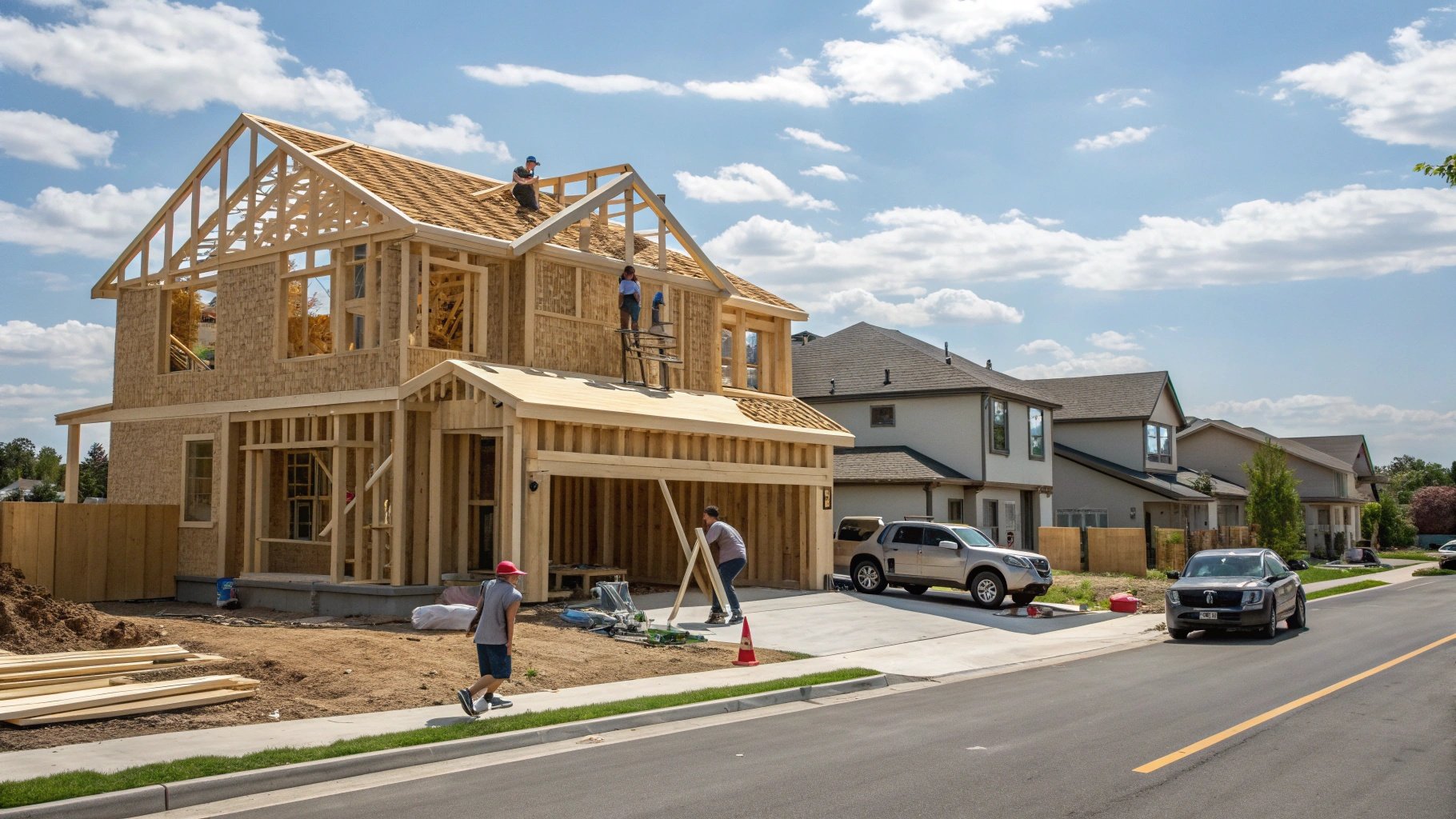
💡 Key Insight: Construction financing is more complex than traditional mortgages because lenders must evaluate both the value of the land and the quality of the proposed construction. Working with an experienced construction loan specialist can save you thousands and prevent costly mistakes throughout the building process.
Types of New Construction Financing
Understanding your financing options is the first step toward building your new home.
🏗️ Construction-to-Permanent Loan
One Loan, One Closing
A construction-to-permanent loan (also called a "single-close" or "one-time-close" loan) combines construction financing and your permanent mortgage into a single loan. You close once, lock your interest rate upfront, and the loan automatically converts to a traditional mortgage when construction completes.
- Lock your rate before construction begins
- One closing means lower fees and less paperwork
- Interest-only payments during construction
- Converts automatically to permanent mortgage
🔨 Construction-Only Loan
Short-Term Construction Financing
A construction-only loan (also called a "stand-alone construction loan") provides short-term financing during the building phase only. When construction completes, you must refinance into a permanent mortgage—requiring a second closing and qualification.
- Typically 6-12 month terms during construction
- Interest-only payments on funds disbursed
- Requires second loan and closing for permanent financing
- Useful if you expect better rates later
🎖️ VA Construction Loan
Zero Down for Eligible Veterans
VA construction loans allow eligible veterans, active-duty service members, and surviving spouses to finance new construction with $0 down payment. These can be structured as construction-to-permanent loans with no PMI and competitive rates backed by the VA guarantee.
- 100% financing with zero down payment
- No private mortgage insurance (PMI) required
- Must meet VA minimum property requirements
- Builder must be VA-approved or approved during process
🏢 Builder Financing
Direct Financing from Production Builders
Many large production builders offer in-house financing or preferred lender partnerships with special incentives. Builder financing often comes with rate buydowns, closing cost assistance, or upgrade credits—but may limit your ability to negotiate purchase price.
- Closing cost credits and incentives ($5,000-$15,000+)
- Streamlined approval with builder's lender
- Potential rate buydowns or upgrade allowances
- Compare carefully against outside lenders
🏦 FHA Construction Loan
Low Down Payment Option
FHA construction loans allow qualified borrowers to finance new construction with as little as 3.5% down. FHA 203(k) construction-to-permanent loans are available through approved lenders, though fewer lenders offer this product compared to conventional construction loans.
- 3.5% minimum down payment requirement
- More flexible credit requirements (580+ scores)
- FHA mortgage insurance required (upfront + annual)
- Must meet FHA property standards and appraisal requirements
💰 Land Loan + Construction Financing
Two-Step Approach
If you already own land or plan to purchase it separately, you'll obtain a land loan first, then construction financing later. Some lenders allow you to roll existing land equity into construction financing, reducing your required down payment on the build.
- Purchase land with land loan or cash first
- Owned land can serve as down payment for construction
- Land must be paid off or refinanced into construction loan
- Equity in land reduces cash needed for construction
Construction-to-Permanent Loans Explained
The most popular choice for custom home builds—one loan, one closing, locked rates, and seamless conversion to permanent financing.

The Construction-to-Permanent Process
Construction-to-permanent loans simplify the building process by combining short-term construction financing with long-term mortgage financing in a single loan product.
- Pre-Approval & Planning: Get pre-approved based on income, credit, and plans/budget for the build
- Lock Your Rate: Lock your permanent mortgage rate before construction begins (protects against rate increases)
- Single Closing: Close once on the full loan amount—saving thousands in duplicate closing costs
- Construction Phase: Lender disburses funds in stages (called "draws") as construction progresses; you pay interest only on disbursed funds
- Inspections & Draws: Lender inspects work at each stage before releasing next draw to builder
- Automatic Conversion: When construction completes and you receive Certificate of Occupancy, loan automatically converts to permanent mortgage
- Standard Mortgage Payments: Begin making principal + interest payments on 15- or 30-year mortgage
Qualifying for Construction-to-Permanent Loans
Lenders have stricter requirements for construction loans compared to traditional mortgages due to higher risk.
- Credit Score: Typically 680+ minimum; 700+ for best rates (higher than traditional mortgages)
- Down Payment: 20-25% down payment is standard for custom builds (higher than traditional mortgages)
- Debt-to-Income Ratio: 43% DTI maximum in most cases (sometimes 45% with strong credit)
- Detailed Plans & Budget: Complete architectural plans, builder contract, itemized budget required
- Qualified Builder: Builder must be licensed, insured, and financially stable (lender verifies)
- Appraisal: Land appraisal + "subject-to-completion" appraisal of finished home value
- Cash Reserves: 6-12 months of mortgage payments in reserves after closing (higher than traditional loans)
Why Choose Construction-to-Permanent?
- Rate Protection: Lock your rate before construction—if rates rise during building, you're protected
- Lower Costs: One closing = one set of closing costs (saves $3,000-$8,000+ vs. two closings)
- Simplified Process: Qualify once, close once, and your loan automatically converts—less paperwork and stress
- Interest-Only During Construction: Lower payments during building phase (typically 6-12 months)
- Predictability: Know your permanent mortgage terms upfront—no surprises at conversion
💡 Pro Tip: If interest rates are currently high, consider a construction-only loan instead. You'll pay interest only during construction, then refinance to a permanent mortgage when rates drop—potentially saving tens of thousands over the life of your loan.
VA Construction Loans: Build with $0 Down
Eligible veterans and active-duty service members can finance new construction with zero down payment using VA-backed construction loans.
Who Qualifies for VA Construction Loans?
VA construction loans are available to the same borrowers eligible for traditional VA loans, with additional construction-specific requirements.
- Veterans: Honorably discharged veterans who meet service requirements
- Active Duty: Active-duty service members with sufficient service time
- National Guard & Reserves: Members with 6+ years of service
- Surviving Spouses: Un-remarried spouses of veterans who died in service or from service-connected disabilities
- Certificate of Eligibility (COE): Must obtain COE from VA proving entitlement
- Credit Requirements: Most lenders require 620+ credit score for VA construction loans
VA-Specific Construction Standards
The VA imposes strict requirements to protect veterans and ensure quality construction.
- Builder Approval: Builder must be VA-approved OR agree to VA approval process (licensing, insurance, financial stability)
- Minimum Property Requirements: Home must meet VA's Minimum Property Requirements (MPRs) for safety and livability
- Plans & Specifications: Complete architectural plans must be submitted and approved by VA
- Construction Timeline: Construction must be completed within reasonable timeframe (typically 12 months)
- VA Inspections: VA appraiser conducts inspections at key stages (foundation, framing, completion)
- Builder Warranty: Builder must provide standard warranties on workmanship and materials
Why VA Construction Loans Are Powerful
- Zero Down Payment: 100% financing with $0 down—build your dream home without depleting savings
- No PMI: No private mortgage insurance required regardless of down payment—saves $100-$300+ monthly
- Competitive Rates: VA-backed loans typically offer lower rates than conventional construction loans
- Flexible Credit: More forgiving credit requirements compared to conventional construction loans
- Limited Closing Costs: VA limits what fees lenders can charge veterans
- Seller/Builder Concessions: Builder can pay up to 100% of your closing costs
- No Prepayment Penalty: Pay off your loan early without penalties
⚠️ Important: VA Construction Loan Availability
Not all lenders offer VA construction loans. This is a specialized product that requires expertise in both VA lending and construction financing. Work with a VA-approved lender experienced in construction loans. Many veterans successfully use VA construction loans for custom builds, but finding the right lender is critical.
VA Construction Loan Costs & Fees
- VA Funding Fee: 2.15% for first use (waived for disabled veterans with 10%+ rating)
- Lender Fees: VA limits origination fees to 1% of loan amount
- Appraisal Fees: Land appraisal + subject-to-completion appraisal ($800-$1,500 total)
- Inspections: VA requires multiple inspections throughout construction (included in appraisal fees)
- Title & Closing Costs: Standard closing costs (builder can pay up to 100%)
- Interest During Construction: Interest-only payments on disbursed funds during building phase
Builder Financing & Incentives
Production builders often offer attractive financing packages through preferred lenders—but should you use builder financing or get your own loan?
Understanding Builder Financing
Large production builders typically partner with mortgage companies (often subsidiaries) to offer financing directly to buyers. These preferred lender relationships come with incentives designed to encourage use of builder financing.
- Preferred Lender Partnerships: Builders partner with specific mortgage companies for streamlined financing
- Incentive Packages: Builders offer credits, rate buydowns, or upgrades for using their preferred lender
- Streamlined Approval: Builder's lender is familiar with communities, timelines, and processes
- Construction Coordination: Builder and lender work together on draws, inspections, and closing timeline
Builder Financing Incentives to Expect
- Closing Cost Credits: $5,000-$15,000+ toward closing costs when using preferred lender
- Rate Buydowns: Temporary (2-1 or 1-0 buydowns) or permanent rate reductions
- Upgrade Credits: Free upgrades or design center credits ($5,000-$25,000 value)
- Reduced Deposit: Lower earnest money requirement with preferred lender
- Faster Approval: Expedited underwriting and approval process
- Waived Fees: Lot premiums, HOA transfer fees, or other costs waived
Builder Financing: Should You Use It?
Advantages:
- Significant incentives can save $10,000-$30,000+ in costs and upgrades
- Streamlined process with coordination between builder and lender
- Faster approvals and smoother construction timeline
- Builder has confidence in financing (may offer better pricing)
Disadvantages:
- Interest rates may be higher than outside lenders (even with buydowns)
- Incentives may be offset by higher home price or inflexible negotiations
- Less flexibility in loan terms and structure
- May pressure buyers into preferred lender without comparison shopping
💡 Smart Strategy: Always compare builder financing against at least 2-3 outside lenders. Calculate total costs over the life of the loan—a 0.25% higher interest rate can cost $20,000+ over 30 years, potentially wiping out incentive savings. Get written quotes and do the math before committing.
Maximizing Builder Financing Benefits
- Get Multiple Quotes: Obtain pre-approvals from outside lenders before meeting builder's lender
- Leverage Competition: Use outside lender quotes to negotiate better terms from builder's lender
- Ask for Incentives Without Financing: Some builders will offer partial incentives even with outside financing
- Calculate Total Cost: Compare APR, interest rate, fees, and incentives to determine true cost
- Negotiate Everything: Purchase price, lot premium, upgrades, closing costs—all are negotiable
- Read Fine Print: Understand contingencies, rate lock periods, and what happens if rates change
New Construction Financing Comparison
Compare the key features of different construction financing options to determine the best fit for your situation.
| Feature | Construction-to-Permanent | VA Construction | Builder Financing |
|---|---|---|---|
| Down Payment | 20-25% typical for custom builds | 0% - Zero down with VA eligibility | Varies (often 3-20% depending on loan type) |
| Number of Closings | One closing (single-close loan) | One closing (VA-backed single-close) | One closing (production builder homes) |
| Rate Lock | Lock rate before construction begins | Lock rate upfront with VA backing | Lock terms vary by builder/lender agreement |
| Mortgage Insurance | None if 20%+ down payment | None - VA loans never require PMI | Depends on loan type and down payment |
| Credit Requirements | 680-700+ typically required | 620+ typical (more flexible than conventional) | Varies by lender (often conventional standards) |
| Builder Requirements | Licensed, insured, lender-approved builder | VA-approved builder or willing to become approved | Builder's own approval process (streamlined) |
| Incentives | None - standard market terms | VA benefits (no PMI, seller concessions allowed) | $10,000-$30,000+ in credits and upgrades |
| Flexibility | High - shop multiple lenders freely | Medium - fewer lenders offer VA construction | Low - tied to builder's preferred lender terms |
| Best For | Custom builds, buyers with 20%+ down | Eligible veterans/military with limited savings | Production builder homes, buyers wanting incentives |
Bottom Line: Your best option depends on your specific situation—VA loans are unbeatable for eligible veterans, construction-to-permanent loans offer flexibility and rate protection for custom builds, and builder financing can provide substantial savings if incentives outweigh any rate premiums. Always compare total costs over the full loan term.
The Construction Financing Process
Understanding the step-by-step process helps you prepare for each phase of construction financing—from pre-approval to final closing.
Pre-Approval & Planning
Begin by getting pre-approved for construction financing. Lenders evaluate your income, credit, assets, and DTI ratio to determine your maximum loan amount. For construction loans, you'll also need preliminary plans and budget estimates to demonstrate the project's feasibility.
- Obtain pre-approval from construction loan lender
- Provide preliminary plans, budget estimates, and builder information
- Lender evaluates land value and "subject-to-completion" home value
- Receive pre-approval amount and terms
Land Acquisition or Verification
If you don't already own land, you'll need to purchase it before construction financing is finalized. If you own land, lenders will appraise it and determine equity available. Land equity can count toward your down payment requirement on the construction loan.
- Purchase land (cash or land loan) if you don't already own it
- Lender orders land appraisal to establish current value
- Land equity calculated and applied toward down payment
- Verify land is clear of liens and building-ready
Finalize Plans, Builder Contract & Budget
Complete architectural plans, sign a fixed-price contract with your builder, and create a detailed itemized budget. Lenders require all of this documentation to approve your construction loan. The contract must specify payment schedules, timelines, and specifications.
- Complete detailed architectural plans and specifications
- Sign fixed-price construction contract with licensed builder
- Prepare itemized budget showing all construction costs
- Submit all documentation to lender for underwriting
Appraisal & Loan Approval
The lender orders a "subject-to-completion" appraisal, which estimates the home's value once construction is complete. This appraisal must meet or exceed your loan amount for approval. Underwriting reviews all documentation and issues final loan approval.
- Lender orders subject-to-completion appraisal
- Appraiser evaluates plans and estimates completed home value
- Underwriting reviews credit, income, plans, budget, and appraisal
- Receive final loan approval and closing disclosure
Closing & Construction Begins
Attend closing to sign loan documents and pay your down payment and closing costs. For construction-to-permanent loans, this is your only closing. The lender establishes a draw schedule tied to construction milestones. Construction begins immediately after closing.
- Attend closing and sign all loan documents
- Pay down payment and closing costs
- Lender establishes draw schedule for fund disbursements
- Construction begins—builder pulls permits and starts work
Construction Phase & Draw Inspections
During construction, your lender disburses funds to the builder in stages (draws) as work progresses. Before each draw, the lender or third-party inspector verifies that work is complete and meets standards. You pay interest only on funds disbursed during this phase.
- Builder completes work in stages per construction schedule
- Lender inspects work before releasing each draw payment
- You make interest-only payments on disbursed funds
- Typical draws: foundation, framing, rough-in, drywall, completion
Final Inspection & Loan Conversion
When construction completes, the lender conducts a final inspection and orders a completion appraisal to verify the home matches plans and is worth the appraised amount. You receive a Certificate of Occupancy from the local building department. Your construction loan converts to a permanent mortgage automatically (construction-to-permanent) or you close on your permanent mortgage (construction-only).
- Builder completes construction and requests final inspection
- Lender orders final completion appraisal
- Receive Certificate of Occupancy from building department
- Construction-to-permanent loan converts automatically to mortgage
- Begin making standard principal + interest payments
- Move into your brand new home!
Understanding Construction Loan Costs
Know what to expect when it comes to fees, interest, and closing costs for construction financing.
| Cost Item | What It Is | Typical Amount | Notes |
|---|---|---|---|
| Down Payment | Upfront equity required for construction loans | 20-25% for conventional; 0% for VA | Land equity can count toward down payment |
| Origination Fee | Lender fee for processing and underwriting loan | 1% of loan amount ($3,000-$6,000 typical) | VA limits this to 1%; negotiate with lender |
| Land Appraisal | Appraisal of land value before construction | $400-$600 | Required even if you already own land |
| Construction Appraisal | Subject-to-completion appraisal of finished home | $600-$1,000 | Estimates value once construction complete |
| Inspection Fees | Lender inspections at each draw stage | $200-$400 per inspection (4-6 total) | Some lenders include in loan costs |
| Construction Interest | Interest-only payments during building phase | Varies by loan amount and rate | Only pay interest on disbursed funds |
| Title & Escrow | Title insurance, settlement, and recording fees | $2,000-$4,000 | Standard closing costs |
| Builder's Risk Insurance | Insurance covering home during construction | $1,000-$3,000 for construction period | Required by lender; builder or buyer pays |
| Permits & Fees | Building permits, impact fees, utility connections | $5,000-$15,000+ varies by location | Typically included in builder's contract |
| Contingency Reserve | Buffer for cost overruns or changes | 10-15% of construction budget | Lenders often require reserves built into loan |
💰 Budget Planning: For a $300,000 construction loan, expect $60,000-$75,000 down payment (20-25%), $10,000-$15,000 in fees and closing costs, and $1,500-$3,000 monthly interest-only payments during construction. Always add 10-15% contingency for unexpected costs.
Construction Financing FAQs
Common questions about financing new construction projects.
What's the difference between construction-to-permanent and construction-only loans?
Construction-to-permanent loans combine construction financing and your permanent mortgage into one loan with one closing. You lock your rate upfront and the loan converts automatically when construction completes. Construction-only loans are short-term (6-12 months) and require a second closing to refinance into a permanent mortgage—meaning two sets of closing costs and re-qualification.
Why do construction loans require larger down payments than regular mortgages?
Construction loans carry higher risk for lenders because the collateral (your home) doesn't exist yet. If something goes wrong during construction or the builder fails, the lender has only land and incomplete construction as security. The 20-25% down payment protects the lender and ensures you have significant equity invested in the project's success.
Can I use a VA loan for new construction?
Yes! Eligible veterans and active-duty service members can use VA construction loans with $0 down payment. However, not all lenders offer VA construction loans—it's a specialized product requiring expertise in both VA lending and construction financing. The builder must be VA-approved or willing to become approved, and the home must meet VA Minimum Property Requirements.
How do interest-only payments work during construction?
During the construction phase (typically 6-12 months), you make interest-only payments on the funds that have been disbursed to your builder—not the full loan amount. As more draws are released and more of your loan is used, your monthly interest payment increases. Once construction completes and the loan converts, you begin making standard principal + interest payments.
What is a "draw schedule" and how does it work?
A draw schedule is the timeline and stages when your lender releases funds to the builder. Typical draw stages include: land/foundation, framing, rough-in (plumbing/electrical), drywall, and completion. Before each draw, the lender or inspector verifies work is complete and meets standards. The builder requests payment, inspection occurs, and funds are released. This protects you by ensuring money is only paid for completed work.
Should I use the builder's preferred lender or shop around?
Always compare! Builder financing often comes with $10,000-$30,000 in incentives (closing costs, rate buydowns, upgrades), but may have higher interest rates. Get written quotes from the builder's lender and at least 2-3 outside lenders. Calculate total costs over 30 years—sometimes a lower rate saves more than incentives provide. Many buyers successfully use outside lenders while negotiating partial incentives from builders.
Can I use land I already own as my down payment?
Yes! If you own land outright (no mortgage), its appraised value can count as equity toward your construction loan down payment requirement. For example, if you own $80,000 in land and need a $400,000 construction loan, your land equity satisfies the 20% down payment ($80,000). The land must be appraised and free of liens. If you have a land loan, you'll typically need to pay it off or roll it into the construction loan.
What happens if construction costs more than expected?
This is why lenders require contingency reserves (10-15% of budget). If costs exceed your budget, you'll need to cover overages out-of-pocket or negotiate with your builder to reduce costs elsewhere. Your lender won't increase your loan amount mid-construction. Always build realistic budgets with professional estimates and maintain cash reserves for unexpected expenses—$20,000-$40,000 cushion is wise for most builds.
Expert Tips for Construction Financing Success
Avoid common mistakes and maximize your success with these insider strategies.
🎯 Choose the Right Builder
Your builder makes or breaks your project. Vet builders thoroughly—check licenses, insurance, references, and past projects. Lenders prefer experienced builders with strong financial standing. A qualified builder improves your loan approval odds and ensures quality construction. Never choose based solely on lowest bid.
📋 Get Detailed Written Bids
Require itemized, fixed-price bids from builders covering all aspects of construction. Vague estimates lead to cost overruns and disputes. Your lender needs detailed budgets for approval. Include allowances for fixtures, flooring, appliances—everything. The more specific your contract, the fewer surprises you'll face.
💰 Budget Conservatively
Add 10-15% contingency to your construction budget for unexpected costs—they always arise. Underestimating costs causes cash crunches mid-project. Also maintain 6-12 months cash reserves after closing. Lenders want to see you can handle surprises without financial stress threatening project completion.
📅 Plan for Construction Delays
Construction almost always takes longer than planned—weather, materials, permits, inspections cause delays. Budget extra months for interest-only payments. If you're selling your current home, don't schedule closings too tightly. Build buffer time into your plans to avoid double housing payments if construction runs long.
🔍 Hire Independent Inspectors
Don't rely solely on lender inspections—they verify work completion, not quality. Hire independent inspectors for critical stages (foundation, framing, pre-drywall, final). Catching issues early saves thousands vs. fixing problems after closing. Quality inspections protect your investment for decades to come.
📸 Document Everything
Take photos and videos at every construction stage—foundation, framing, plumbing, electrical, before drywall. Documentation helps resolve disputes, proves work completion for draws, and provides records for future repairs or remodeling. Create a project folder with all contracts, change orders, permits, and invoices.
🤝 Communicate Constantly
Maintain regular communication with your builder, lender, and inspector. Visit the job site weekly (or more). Address concerns immediately—small issues become big problems if ignored. Respond quickly to lender requests for documentation. Proactive communication prevents delays and misunderstandings that cost time and money.
⚖️ Understand Your Contract Rights
Read every word of your construction contract before signing. Understand payment schedules, timelines, warranties, change order processes, and dispute resolution procedures. Have a real estate attorney review complex contracts. Know your rights if the builder fails to perform or abandons the project. Don't sign anything you don't fully understand.
Critical: Work with Construction Loan Experts
Construction financing is complex—specialized expertise is essential for success.
⚠️ Don't Navigate Construction Financing Alone
Construction loans are fundamentally different from traditional mortgages. They require expertise in construction processes, draw schedules, builder evaluation, and construction-specific underwriting. Attempting to navigate construction financing without experienced guidance leads to costly mistakes, delays, and potentially failed projects. Work with lenders and agents who specialize in construction financing and have track records of successful builds.
🏦 Construction Loan Specialist
Expertise in construction-to-permanent loans, VA construction financing, and draw management
🔍 Builder Vetting
Evaluates builder qualifications, financial stability, and lender acceptance
📊 Budget Analysis
Reviews construction budgets for accuracy and completeness to prevent cost overruns
📋 Contract Review
Ensures construction contracts protect your interests and meet lender requirements
🎯 Timeline Coordination
Manages draw schedules, inspections, and conversion timeline for smooth process
💡 Problem Solving
Addresses issues quickly when delays, cost overruns, or disputes arise during construction
Ready to Finance Your New Construction Project?
Building your dream home starts with securing the right financing. Whether you're exploring construction-to-permanent loans, VA construction financing, or builder financing options, expert guidance makes the difference between a smooth build and a stressful struggle. Let's discuss your project and find the perfect financing solution for your needs.
Your dream home awaits. Let's build it together with the right financing. 🏡

AXEN Realty Powered Lic.#9006127


©2026 Copyright DFWAreaHomes.com - All Rights Reserved.